
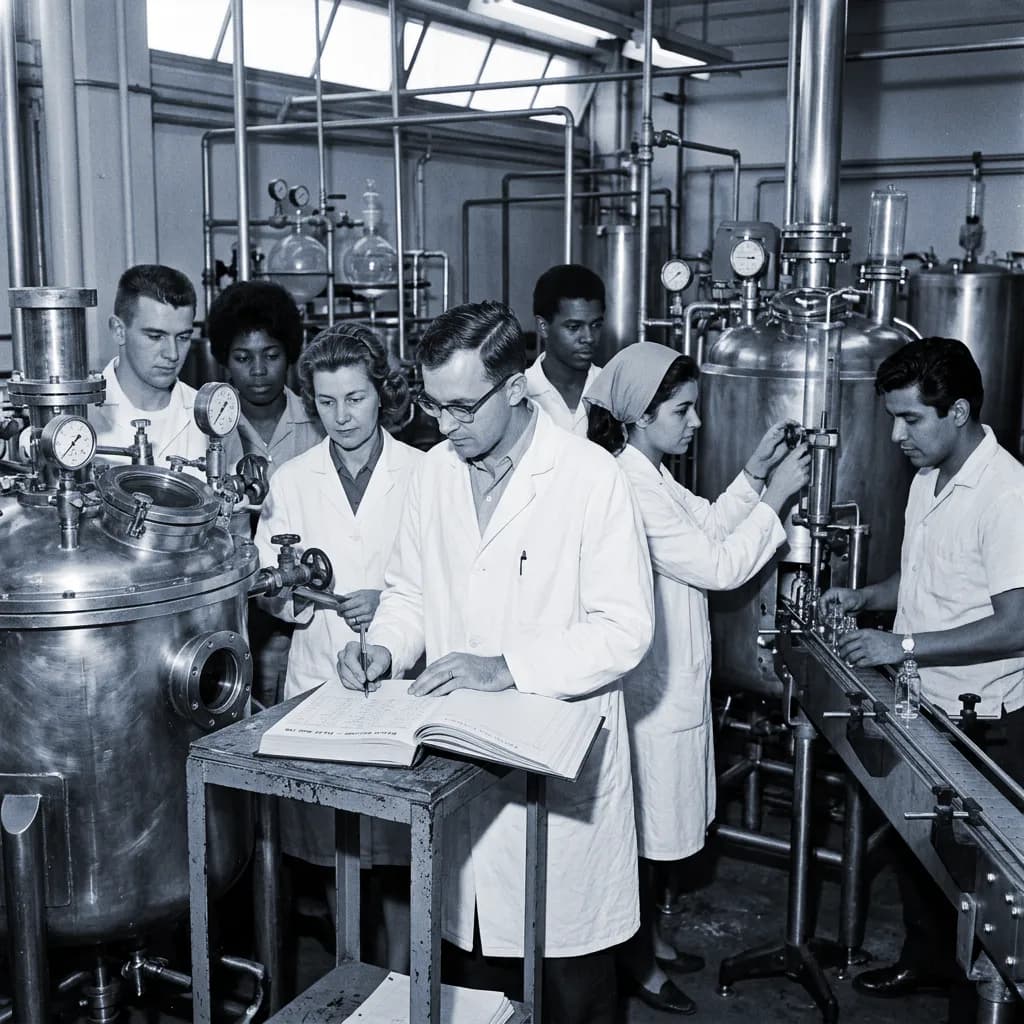
How do pharma and biotech companies transfer production processes between sites safely, in a GMP-compliant manner and on schedule?
We support Production Transfer and Scale-Up to production scale: gap analysis, handover of process and analytical documentation, process validation per ICH Q7 and Annex 15. Starting the variation under Regulation (EC) No 1234/2008 only once validation is done loses months, because the approval path does not run in parallel.
Overview
What challenges arise during production transfer and scale-up?
Tech transfer and scale-up from strategy to PPQ · ICH Q7, ICH Q8, ICH Q9(R1), ICH Q10, Annex 15 of the EU GMP Guide
Last updated: June 13, 2026
The technology transfer is one of the highest-risk steps in the product lifecycle, because process knowledge, documentation and regulatory status all have to move from the donor site to the receiving site at the same time.
- Process parameters from laboratory scale cannot be transferred one-to-one into production. The scale-up has to adjust the critical process parameters on a scientifically justified basis; under ICH Q8 and quality risk management per ICH Q9(R1), these adjustments must be derived on a risk basis, not estimated from experience.
- Incomplete knowledge transfer leads to production disruptions at the new site. Without a structured transfer of knowledge in the sense of the pharmaceutical quality system per ICH Q10, the receiving site lacks the critical process interdependencies that the donor knows implicitly.
- The GMP documentation is inadequately adapted to the new site. Batch records, production SOPs and validation packages have to be recreated for the equipment at the receiving site; under ICH Q7 and 21 CFR Part 211, the documentation is part of the evidence, not just an accessory.
- Regulatory variations for the change of site are initiated too late. A Type IB or Type II variation under Regulation (EC) No 1234/2008 has a lead time; an approval pathway not started in parallel with the technical transfer blocks the release of the first commercial batch even though the technical side is ready.
- Process validation at the receiving site is started without predefined acceptance criteria. Annex 15 of the EU GMP Guide and the FDA process validation model require criteria to be defined in advance for the PPQ; if they are derived after the fact from the batch data, the validation loses its evidentiary character.
Services
How we support you
Transfer strategy & gap analysis
Assessment of transferability between the donor and receiving site and identification of technical, analytical and regulatory gaps. Deliverable: a structured transfer plan with milestones and a prioritized gap list.
Scale-up support & process optimization
Scientific support for the scale-up from laboratory to commercial scale, with adjustment of critical process parameters. Deliverable: documented, DoE-based parameter derivation in line with ICH Q8 and ICH Q9(R1).
GMP transfer documentation
Adaptation and creation of GMP-compliant batch records, production SOPs and test instructions for the equipment at the receiving site. Deliverable: a complete documentation package referenced to the receiving site in line with ICH Q7 and 21 CFR Part 211.
Variation strategy & regulatory pathway
Early definition of the variation route for the change of site and alignment of the submission timing with the technical transfer. Deliverable: a variation strategy with classification under Regulation (EC) No 1234/2008 (Type IB/II) and a timeline.
How we work together
What it comes down to
A production transfer is complete only when there is evidence that the new site produces the same result.
Technology, documentation and the regulatory pathway run at the same time and have to be coordinated with one another. The first is the technical transfer with scale-up of the critical process parameters per ICH Q8 and quality risk management per ICH Q9(R1).
The second is the GMP documentation with new batch records and SOPs for the receiving site per ICH Q7 and 21 CFR Part 211. The third is the regulatory pathway with the variation under Regulation (EC) No 1234/2008.
The most common mistake is to place the regulatory pathway sequentially behind the technical work: the validated process is then ready, but the first commercial batch cannot be released because the variation is still under review.
The gap analysis states from the outset which workstream is critical and where the donor site's implicit process knowledge is at risk of being lost.
This gap analysis makes it possible to start the variation pathway in parallel with the technical work, to plan the analytical method transfer as a separate workstream and to set up the process validation with predefined acceptance criteria in line with Annex 15 of the EU GMP Guide and the FDA process validation model.
Open points are otherwise settled in the PPQ, where a failed batch sets the project back by an entire validation cycle.
| Feature | Scale-up | Tech transfer |
|---|---|---|
| Object | increase in scale from laboratory to production | transfer of a process between sites or items of equipment |
| Regulatory requirement | ICH Q8, quality risk management per ICH Q9(R1) | ICH Q8, quality risk management per ICH Q9(R1) |
Our approach
Our approach
Step
Result
Gap analysis
Prioritized gap list across technology, analytics, documentation and regulatory affairs between the donor and receiving site.
Transfer plan & variation strategy
Structured transfer plan with milestones and a defined variation route under Regulation (EC) No 1234/2008, started in parallel with the technical work.
Scale-up & parameter adjustment
Scientifically justified, documented adjustment of the critical process parameters in line with ICH Q8 and ICH Q9(R1).
Transfer GMP documentation
Batch records, SOPs and test instructions created for the receiving site and substantiated in line with ICH Q7 and 21 CFR Part 211.
Qualification & process validation
Qualifications and PPQ carried out and documented with predefined acceptance criteria in line with Annex 15 of the EU GMP Guide.
First commercial batch
Releasable first commercial batch at the receiving site, with the variation granted and the validation package completed.
Common pitfalls
Where projects commonly fail
The variation is only submitted once validation is complete.
A Type IB or Type II variation under Regulation (EC) No 1234/2008 has a processing time at the authority; placing the approval pathway sequentially behind the technical work means waiting for clearance even though the process is already validated. The pathway must be planned in parallel from the outset.
Process knowledge is transferred incompletely.
The donor site often knows critical interdependencies implicitly; without a structured knowledge transfer per ICH Q10, the receiving site lacks them. The result is production disruptions that surface during validation as deviations and set the project back.
Process parameters are taken over one-to-one from laboratory scale.
What works in the lab does not scale linearly into production. If critical parameters are not adjusted on a risk basis in line with ICH Q8 and ICH Q9(R1), yield and quality deviate at the new site, and the PPQ fails on batches that do not hold the acceptance criteria.
PPQ acceptance criteria are only derived from the batch data.
Annex 15 of the EU GMP Guide and the FDA process validation model require criteria to be defined in advance; adjusting them retrospectively to the measured values loses the evidentiary character of the validation and provokes inspection findings at the new site.
The analytical method transfer is underestimated.
Transferring the analytics to the QC laboratory of the receiving site requires its own comparability studies; if it is not planned as a separate workstream, missing validated methods block the release of the PPQ batches even though production is ready.
Supply Chain & Technical Operations
Do any of these pitfalls apply to you?
In a first call we assess your situation and say what needs clarifying first in your case. Without obligation, reply usually within one working day.
FAQ
Frequently asked questions
Sources
- EU GMP Guide, Annex 15 (qualification and validation), primary text
- ICH Q7, Q8, Q9(R1), Q10, Q12 (ICH guidelines)
- FDA Guidance for Industry: Process Validation, General Principles and Practices
- Regulation (EC) No 1234/2008 (variations to marketing authorisations), primary text
- 21 CFR Part 211 (cGMP for finished pharmaceuticals)
Image notice: The images on this page were generated using artificial intelligence. They do not depict real people, places, or events.
Life Science Journal
Regulatory updates, straight to your inbox.
New requirements, authority decisions and practice notes. Once a month, unsubscribe any time.
Case Studies
What this looks like in practice
Related insights
All insights →Regulations & standards considered
- EU GMP Guide, Annex 15 (qualification and validation)
- ICH Q7 (Good Manufacturing Practice for Active Pharmaceutical Ingredients)
- ICH Q8 (Pharmaceutical Development)
- ICH Q9(R1) (Quality Risk Management)
- ICH Q10 (Pharmaceutical Quality System)
- ICH Q12 (Technical and Regulatory Considerations for Pharmaceutical Product Lifecycle Management)
- FDA Process Validation Guidance (Stage 1-3, incl. PPQ)
- 21 CFR Part 211 (cGMP for finished pharmaceuticals)
- Regulation (EC) No 1234/2008 (variations to marketing authorisations, Type IB/II)
Related topics
Process Validation →
Qualification and PPQ in line with Annex 15 and the FDA process validation model at the receiving site
GMP Consulting (Good Manufacturing Practice) →
GMP compliance and pharmaceutical quality system at the new site in line with ICH Q7 and ICH Q10
Biotech Scale-up →
Scale-up of biotechnological processes with their own scaling questions
Supply Chain Governance →
Steering CDMO and supplier relationships beyond the transfer
Have a concrete project?
Briefly outline your situation. We'll respond with an initial assessment, usually within one business day.
Prefer direct? +41 61 271 23 80
info@theentourage.ch
- Reply usually within one working day
- 4 locations: DE · CH · IT · US
- 100% life sciences