
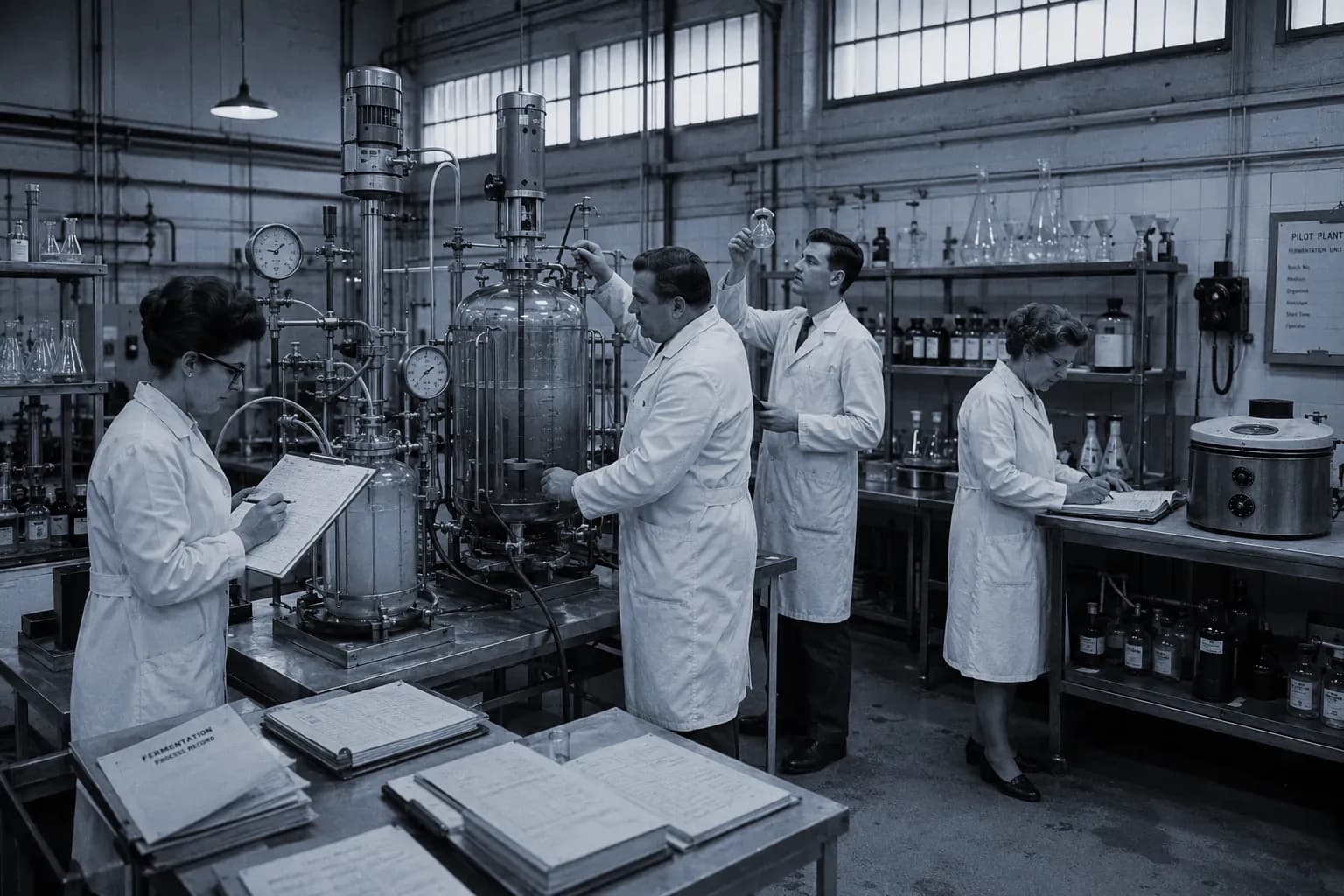
How do biotech companies scale a biological process from laboratory to production scale without losing yield, product quality, or comparability to the clinical material?
We support Biotech Scale-up from laboratory to commercial scale: critical process parameters, upstream and downstream, process validation per Annex 15 of the EU GMP Guide. Comparability decides, not the bioreactor: planning the ICH Q5E demonstration only after the scale change puts the clinical data set at risk.
Overview
Which questions distinguish the scale-up of biological processes from chemical production?
Scale-up of biological processes from characterization to PPQ · ICH Q5E, ICH Q8, ICH Q9(R1), ICH Q10, ICH Q11, Annex 15 of the EU GMP Guide
Last updated: October 3, 2026
A biological process cannot be extrapolated with a single scaling factor, because living cells respond to oxygen transfer, shear forces, and metabolic conditions that shift with scale.
- Upstream parameters do not scale linearly. Oxygen transfer, mixing time, and shear stress change with reactor volume and affect cell growth and product quality. Under ICH Q8 and the quality risk management under ICH Q9(R1), the critical process parameters must be derived on a risk basis, not carried over from laboratory scale.
- Product quality is process-dependent. The glycosylation, aggregation, and impurity profile of a biologic arise within the process; a change of scale can shift a quality attribute without the release specification under ICH Q6B revealing it. The comparability demonstration under ICH Q5E must therefore go beyond the routine specification.
- Downstream must grow with the higher titer. As upstream yield increases, the loadings of the chromatography and filtration steps shift; without adaptation, the purification loses resolution and impurity clearance falls below the required limit.
- Comparability to the clinical material determines the data set. If the commercial material is not demonstrated to be comparable to the material used in the studies, the clinical evidence does not hold; the comparability plan under ICH Q5E belongs before the scale change, not after.
- Sterile and contamination-critical steps follow Annex 1. Cell culture and aseptic processing of biological products are subject to the contamination control requirements under Annex 1 of the EU GMP Guide; the contamination control strategy must align with the facility design at target scale.
Services
How we support you
Process characterization & CPP derivation
Risk-based identification and characterization of the critical process parameters for upstream and downstream through DoE-supported studies. Deliverable: documented parameter derivation justified under ICH Q8 and ICH Q11, with a defined Design Space or Proven Acceptable Range.
Upstream & downstream scale-up
Scientific support of the scale change with adjustment of oxygen transfer, mixing time, and purification loadings. Deliverable: documented scale-up rationale for each process step with an assessment of the impact on the critical quality attributes.
Comparability strategy under ICH Q5E
Planning and support of the comparability demonstration between the clinical and the scaled-up commercial material. Deliverable: comparability protocol with quality, stability, and, where applicable, functional comparison criteria under ICH Q5E and ICH Q6B.
Contamination control & facility design
Alignment of the contamination control strategy and the aseptic process steps with the facility design at target scale. Deliverable: assessment of the steps against the requirements under Annex 1 of the EU GMP Guide, with an action list for qualification.
Variation strategy for the scale change
Definition of the regulatory path for the scale change and alignment of the submission timing with the technical implementation. Deliverable: variation strategy with classification under Regulation (EC) No 1234/2008 and a timeline.
How we work together
What it comes down to
In biological scale-up, the timeline depends on when the parallel workstreams converge.
The workstreams are the process characterization with risk-based derivation of the critical process parameters under ICH Q8 and quality risk management under ICH Q9(R1), the comparability strategy under ICH Q5E, which ties the scaled-up material to the clinical material, and the process validation with predefined acceptance criteria under Annex 15 of the EU GMP Guide.
The most common mistake is to place the comparability demonstration after the scale change: if a quality attribute then shifts, the reference point is missing, and the commercial material no longer supports the clinical data set.
The process analysis starts by setting apart which step does not scale linearly and where upstream yield and downstream capacity threaten to diverge.
This makes it possible to define the comparability plan before the scale change, to align contamination control under Annex 1 of the EU GMP Guide with the facility design at target scale, and to set up the process validation cleanly.
Whatever is left open here is settled in the PPQ, where a batch outside the acceptance criteria sets the project back by a complete validation cycle.
Our approach
Our approach
Step
Result
Process analysis & risk assessment
Assessed scalability for each process step and a prioritized list of the critical process parameters under ICH Q8 and ICH Q9(R1).
Characterization & Design Space
DoE-supported characterized CPPs with a defined Design Space or Proven Acceptable Range under ICH Q11.
Comparability plan
Comparability protocol defined before the scale change under ICH Q5E, with quality, stability, and functional criteria.
Upstream & downstream scale-up
Scaled-up, documented process parameters with a demonstrated impact on the critical quality attributes.
Process validation & PPQ
PPQ conducted and documented with predefined acceptance criteria under Annex 15 of the EU GMP Guide and the FDA process validation model.
Comparability & release
Demonstrated comparability to the clinical material and release-ready commercial material with a completed validation package.
Common pitfalls
Where projects commonly fail
The comparability demonstration is planned only after the scale change.
If a quality attribute then shifts with scale, the reference point to the clinical material is missing without a protocol defined in advance under ICH Q5E; in the worst case, the commercial product is considered a different material and no longer supports the clinical data set.
Upstream parameters are extrapolated with a scaling factor.
Oxygen transfer and shear stress change non-linearly with reactor volume; if the critical process parameters are not adjusted on a risk basis under ICH Q8 and ICH Q9(R1), cell density and product quality deviate at production scale and the PPQ fails on batches outside the acceptance criteria.
Downstream is not adapted to the higher titer.
A better upstream yield overloads the chromatography and filtration steps as originally designed; impurity clearance declines, and the specification under ICH Q6B is no longer met at commercial scale.
The PPQ acceptance criteria are derived only from the batch data.
Annex 15 of the EU GMP Guide and the FDA process validation model require predefined criteria; if they are adjusted retrospectively to the measured values, the validation loses its evidentiary character and provokes findings during inspection.
Contamination control is planned decoupled from the facility design.
Aseptic process steps of biological products are subject to Annex 1 of the EU GMP Guide; if the contamination control strategy does not match the facility design at target scale, the gap surfaces only during qualification, when modifications are expensive.
Supply Chain & Technical Operations
Do any of these pitfalls apply to you?
In a first call we assess your situation and say what needs clarifying first in your case. Without obligation, reply usually within one working day.
FAQ
Frequently asked questions
Sources
- ICH Q5E (Comparability of Biotechnological/Biological Products Subject to Changes in Their Manufacturing Process): ICH guideline
- ICH Q6B, Q7, Q8, Q9(R1), Q10, Q11: ICH guidelines
- EU GMP Guide, Annex 1 (manufacture of sterile medicinal products) and Annex 15 (qualification and validation): primary text
- FDA Guidance for Industry: Process Validation: General Principles and Practices
- 21 CFR Part 211 (cGMP for finished pharmaceuticals)
- Regulation (EC) No 1234/2008 (variations to marketing authorisations): primary text, amended by Delegated Regulation (EU) 2024/1701
Image notice: The images on this page were generated using artificial intelligence. They do not depict real people, places, or events.
Life Science Journal
Regulatory updates, straight to your inbox.
New requirements, authority decisions and practice notes. Once a month, unsubscribe any time.
Projects from this industry
What we have worked on in this industry


Related insights
All insights →Regulations & standards considered
- ICH Q5E (comparability of biotechnological/biological products subject to changes in their manufacturing process)
- ICH Q6B (specifications for biotechnological/biological products)
- ICH Q8 (Pharmaceutical Development)
- ICH Q9(R1) (Quality Risk Management)
- ICH Q10 (Pharmaceutical Quality System)
- ICH Q11 (development and manufacture of drug substances, chemical and biotechnological/biological entities)
- ICH Q7 (Good Manufacturing Practice for active pharmaceutical ingredients)
- EU GMP Guide, Annex 1 (manufacture of sterile medicinal products)
- EU GMP Guide, Annex 15 (qualification and validation)
- FDA Process Validation Guidance (Stage 1–3, incl. PPQ)
- 21 CFR Part 211 (cGMP for finished pharmaceuticals)
- Regulation (EC) No 1234/2008 (variations to marketing authorisations), as amended by Delegated Regulation (EU) 2024/1701
Related topics
Production Transfer & Scale-Up →
Cross-site technology transfer and general scale-up under ICH Q7 and Annex 15
Process Validation →
Qualification and PPQ under Annex 15 and the FDA process validation model at target scale
Annex 1 (Sterile Manufacturing) →
Contamination control of sterile biologics under Annex 1 of the EU GMP Guide
GMP Consulting (Good Manufacturing Practice) →
GMP compliance and pharmaceutical quality system under ICH Q7 and ICH Q10 in commercial operation
Have a concrete project?
Briefly outline your situation. We'll respond with an initial assessment, usually within one business day.
Prefer direct? +41 61 271 23 80
info@theentourage.ch
- Reply usually within one working day
- 4 locations: DE · CH · IT · US
- 100% life sciences