
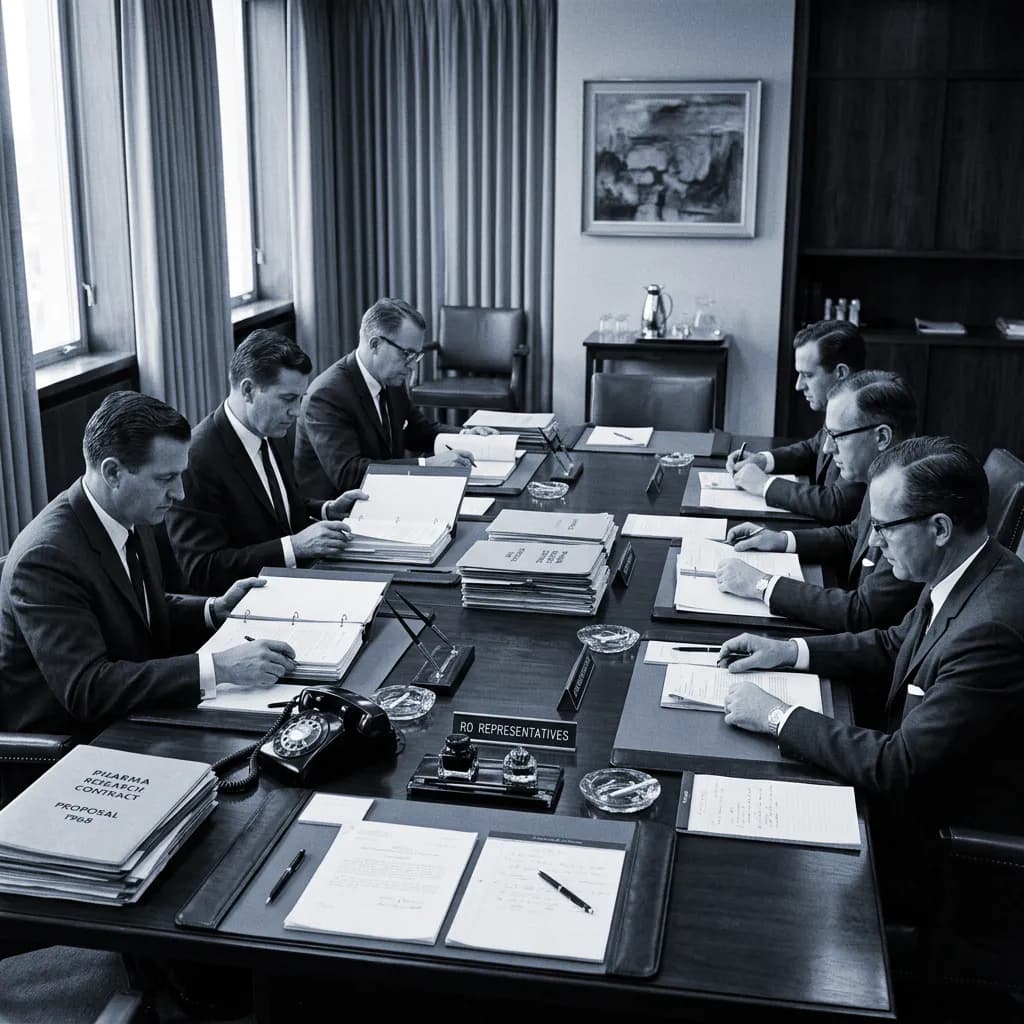
How do you select the right CRO for your clinical trial and manage it so that sponsor responsibility is preserved?
We support sponsors in the selection and oversight of Contract Research Organizations, from the request for proposal through contract design to study close-out. Under ICH E6 the sponsor delegates tasks to the CRO, not its responsibility: without documented tracking a deviation surfaces only in an inspection finding.
Overview
What does engaging a CRO mean for the sponsor's responsibility?
Support from RFP to close-out · Sponsor oversight per ICH E6(R3) GCP
Last updated: August 2, 2026
A CRO takes on operational tasks of a clinical trial: study management, monitoring, data management, regulatory submissions. Under ICH E6(R3) Good Clinical Practice, however, the sponsor remains responsible for the quality and integrity of the trial data, even when it delegates tasks.
- Delegation is not a transfer of responsibility: under ICH E6(R3), delegated tasks must be specified in writing, and the sponsor must oversee the delegated activities. Which task lies with the CRO and which remains with the sponsor belongs in a documented responsibility matrix.
- Selection on price rather than suitability: if the CRO is chosen primarily on bid price instead of indication experience, geographic reach and phase expertise, the project incurs corrective management costs that erode the price advantage.
- Missing sponsor oversight: ICH E6(R3) requires the sponsor to perform risk-based quality oversight of the outsourced activities. Without defined performance indicators and documented escalation paths, this oversight cannot be evidenced in an inspection.
- Data under applicable records requirements: where the CRO's electronic trial data and systems are processed, the requirements of 21 CFR Part 11 apply in FDA-regulated trials. Responsibility and evidence for this remain with the sponsor.
- Scope of the regulation: clinical trials of medicinal products in the EU are governed by the Clinical Trials Regulation (EU) No 536/2014, US trials by 21 CFR Part 312. The CRO scope and the oversight requirements differ depending on the applicable framework.
Services
How we support you
CRO selection & request for proposal
A structured RFP process with a documented requirements profile, a market analysis of suitable CROs by indication, geography and capacity, and an evaluation of the proposals. Deliverable: a traceable capabilities assessment with a scoring matrix as the basis for the decision.
Governance & oversight framework
Building the communication structure, escalation paths and reporting requirements plus a responsibility matrix in line with ICH E6(R3). Deliverable: a documented oversight framework with a review-meeting cadence, issue log and reporting formats.
Ongoing CRO performance management
Regular assessment of the CRO against agreed performance indicators such as recruitment progress, source data verification status, TMF completeness and reporting timeliness. Deliverable: periodic performance reports with documented escalation in the event of deviations.
Contract design & renegotiation
Support with scope definition, milestones and performance clauses in the CRO contract, plus preparation of renegotiations in the event of scope changes or performance problems. Deliverable: an agreed scope and responsibility definition as the contractual basis.
How we work together
What it comes down to
Engaging a CRO shifts the work, not the responsibility. Under ICH E6(R3) Good Clinical Practice, the sponsor delegates operational tasks but remains responsible for the quality and integrity of the trial data. This implies a fixed sequence: first the scope has to be settled, because it determines the responsibility matrix.
The responsibility matrix gives rise to the performance indicators against which the CRO is measured. And only from these indicators can the oversight framework be derived that holds up as evidence in an audit.
A sponsor that begins with selection before the scope is defined buys in services it cannot then manage in a defensible way. The bottleneck then moves from the contract into the running trial.
Once the trial is running, active and passive oversight differ in when a problem surfaces. A passive setup reacts to problems once they become visible in the Trial Master File or in a GCP inspection; an active setup surfaces the same finding earlier, through documented review meetings, an issue log and defined escalation paths.
Before a request for proposal goes out, we put the scope and responsibility matrix in place, so that subsequent management runs against indicators agreed in advance rather than improvising.
Our approach
Our approach
Step
Result
Needs & scope definition
A defined CRO scope, responsibility matrix and requirements profile as the basis for the RFP.
RFP & selection
An evaluated proposal comparison, a documented capabilities assessment and a substantiated CRO decision.
Contract & onboarding
An agreed contract with defined milestones and performance indicators, and an established governance structure.
Oversight setup
An implemented oversight framework with review cadence, issue log and reporting formats in line with ICH E6(R3).
Ongoing management
Periodic performance reviews against performance indicators, with documented escalation and corrective action.
Close-out & audit
A supported study close-out, a completed sponsor audit and a handed-over audit report with CAPA recommendations.
Common pitfalls
Where projects commonly fail
The CRO is selected primarily on bid price.
If the technical suitability for the indication or trial phase is missing, the project later incurs corrective and remediation costs that exceed the original price advantage and strain the timeline.
The responsibility matrix remains undefined.
When the contract leaves open which task lies with the CRO and which with the sponsor, project drift sets in; under ICH E6(R3), delegated tasks must be specified in writing, otherwise the evidence is missing in an audit.
Sponsor oversight is run passively.
Without defined performance indicators and documented review meetings, problems are escalated only late; missing oversight of the delegated activities is demonstrable finding material in a GCP inspection under ICH E6(R3).
The CRO's electronic systems are not checked against records requirements.
In FDA-regulated trials, responsibility for compliance with 21 CFR Part 11 remains with the sponsor; unchecked CRO systems create data integrity risks that surface only in the inspection.
The Trial Master File is left to the CRO without ongoing control.
An incomplete or belatedly maintained TMF structure is noticed at close-out or in the inspection; responsibility for completeness remains with the sponsor.
Product Development & Regulatory Strategy
Do any of these pitfalls apply to you?
In a first call we assess your situation and say what needs clarifying first in your case. Without obligation, reply usually within one working day.
FAQ
Frequently asked questions
Sources
- ICH E6(R3) Good Clinical Practice (EMA/CHMP/ICH/135/1995), Step 4 of 6 January 2025. Sponsor responsibilities and delegation to CROs
- Regulation (EU) No 536/2014 (Clinical Trials Regulation), primary text
- 21 CFR Part 312 and 21 CFR Part 11, Code of Federal Regulations, US FDA
Image notice: The images on this page were generated using artificial intelligence. They do not depict real people, places, or events.
Life Science Journal
Regulatory updates, straight to your inbox.
New requirements, authority decisions and practice notes. Once a month, unsubscribe any time.
Projects from this industry
What we have worked on in this industry


Related insights
All insights →Regulations & standards considered
- ICH E6(R3) Good Clinical Practice (EMA/CHMP/ICH/135/1995)
- Regulation (EU) No 536/2014 (Clinical Trials Regulation, CTR)
- 21 CFR Part 312 (Investigational New Drug Application)
- 21 CFR Part 11 (Electronic Records and Electronic Signatures)
Related topics
Clinical Project Management →
Operational study leadership in which CRO oversight is embedded
Clinical Monitoring →
Monitoring services as a centrally delegated CRO task
Good Clinical Practice (GCP) →
GCP requirements per ICH E6 as the basis of CRO oversight
GxP Audits (GMP, GLP, GCP) →
Sponsor audit of the CRO and CAPA follow-up
Interim Management →
When capacity joins your own team instead of going to a CRO
Have a concrete project?
Briefly outline your situation. We'll respond with an initial assessment, usually within one business day.
Prefer direct? +41 61 271 23 80
info@theentourage.ch
- Reply usually within one working day
- 4 locations: DE · CH · IT · US
- 100% life sciences