
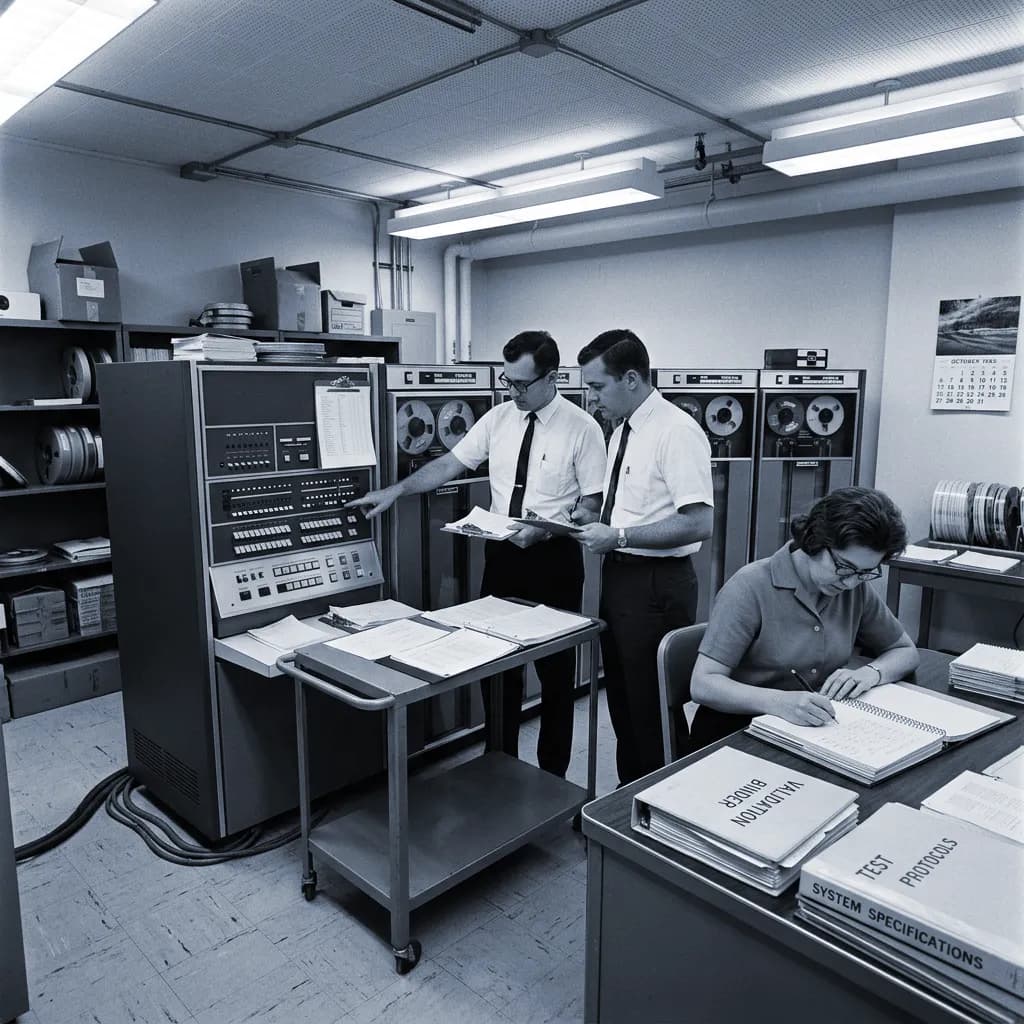
How do you validate computerized systems (CSV) across their lifecycle under GAMP 5 and EU GMP Annex 11?
We support Computer System Validation (CSV) under GAMP 5 and EU GMP Annex 11: system classification, URS, IQ, OQ, PQ, validation report and lifecycle maintenance. The risk classification at the start sets the effort: validating a standard system like a custom build burns capacity that data integrity then lacks.
Overview
What do Annex 11 and 21 CFR Part 11 require of computerised systems?
CSV across all industries · GAMP 5, EU GMP Annex 11, FDA 21 CFR Part 11
Last updated: June 13, 2026
The EU GMP Guide Annex 11 and FDA 21 CFR Part 11 require every GMP-relevant IT system to be demonstrably fit for its intended use and to keep its data integral across the entire lifecycle.
- Risk-based validation scope instead of a one-size-fits-all approach: GAMP 5 classifies systems from standard software to custom development; without this classification, either too much is tested or a critical system is under-validated, and both are inspection findings.
- A complete, traceable validation package: URS, functional specification, traceability matrix, IQ, OQ and PQ must be linked without gaps so that every requirement points to a test record. Annex 11 requires an end-to-end specification and testing chain.
- Data integrity according to ALCOA principles: audit trail, access control and electronic signatures under Annex 11 and 21 CFR Part 11 must be technically implemented and configured, not merely described in an SOP.
- Change control and revalidation in operation: software updates, operating system upgrades and configuration changes without an impact assessment invalidate the validated state. The validated state is a lifecycle, not a one-off project closure.
Services
How we support you
Risk-based validation strategy under GAMP 5
Classification of your systems into the GAMP 5 categories and derivation of the validation scope per system. Deliverable: a validation master plan with a justified risk and GxP-criticality assessment for each system.
Complete validation package from URS to PQ
Preparation of the user requirement specification, functional specification, traceability matrix as well as IQ, OQ and PQ protocols with test scripts. Deliverable: a validation dossier ready for inspection against Annex 11, including the validation report.
CSV lifecycle & periodic review
Establishing the periodic system review, maintaining the validated state and preparing for inspections. Deliverable: a periodic review procedure with criteria that evidence the validated state across the system's lifetime.
How we work together
What it comes down to
Computer system validation is decided by scope, not by test volume. The EU GMP Guide Annex 11 and FDA 21 CFR Part 11 do not require maximum effort, but an effort that matches the risk of the system.
That is why the GAMP 5 classification decides the whole project before anything else: a standard system essentially needs a supplier assessment and a PQ under real conditions, while a configured or bespoke system needs the full chain of URS, functional specification, traceability matrix, IQ, OQ and PQ.
Skip this classification and you validate non-critical systems too deeply and GxP-critical ones too shallowly, and this imbalance is what an inspector finds first.
The second difficulty begins after release. A validation report proves the state at the cut-off date, not for the system's lifetime. Change control and periodic review keep the validated state in force: every update and every upgrade needs an impact assessment that defines the revalidation scope before it goes live.
In parallel, data integrity must take hold technically in line with the ALCOA principles: an enabled, tamper-proof audit trail and role-based access control under Annex 11 and 21 CFR Part 11, not just as SOP text. Take up either strand late, lifecycle or data integrity, and the inspection brings it back, expensively.
Our approach
Our approach
Step
Result
System assessment & classification
System inventory with GxP criticality and GAMP 5 category per system, with the validation scope derived from it.
Validation plan
Validation plan with roles, acceptance criteria, risk assessment and test scope, aligned with QA.
Specification & qualification
URS, functional specification and traceability matrix as well as executed IQ, OQ and PQ protocols with documented results.
Validation report
Final report with an assessment of deviations, releasing the system for GMP use.
Lifecycle & change control
Periodic review, change control integration and revalidation logic established in ongoing operation.
Common pitfalls
Where projects commonly fail
Every system is validated to the same depth.
Standard software with no configuration receives the same test scope as a custom development under GAMP 5. The result is excessive effort on non-critical systems while GxP-critical systems are tested too sparingly, which is the most common finding from an incorrect risk classification.
The traceability matrix is missing or not end-to-end.
Annex 11 requires every requirement from the URS to be traceable through to a test record. If the linkage is reconstructed only at project close, requirements without test coverage surface and are treated as a gap in the audit.
The audit trail is assumed but not verified.
Many systems technically provide an audit trail, but it is switched off, not tamper-proof or configured in a way that is not reviewable. Annex 11 and 21 CFR Part 11 require an effective, enabled and regularly reviewed audit trail.
Software updates go in without an impact assessment.
A patch or operating system upgrade is applied without assessing the validated state. The validation status is thereby formally invalidated. An inspector spots this from a version discrepancy between the validation report and the production system.
Supplier documentation is adopted unchecked.
The software vendor's test documentation does not replace your own qualification. Without a supplier assessment and your own PQ under real process conditions, it remains open whether the system performs as intended in the specific use case.
Quality Management & Compliance
Do any of these pitfalls apply to you?
In a first call we assess your situation and say what needs clarifying first in your case. Without obligation, reply usually within one working day.
FAQ
Frequently asked questions
Sources
- EU GMP Guide Annex 11 (Computerised Systems), primary text
- FDA 21 CFR Part 11 (Electronic Records; Electronic Signatures), primary text
- GAMP 5 (ISPE Good Automated Manufacturing Practice, A Risk-Based Approach to Compliant GxP Computerised Systems)
- EMA Q&A: Good Manufacturing Practice, Data Integrity; PIC/S PI 041 (Data Management and Integrity)
Image notice: The images on this page were generated using artificial intelligence. They do not depict real people, places, or events.
Case Studies
What this looks like in practice


Related insights
All insights →Regulations & standards considered
- EU GMP Guide Annex 11 (Computerised Systems)
- FDA 21 CFR Part 11 (Electronic Records; Electronic Signatures)
- GAMP 5 (ISPE Good Automated Manufacturing Practice, A Risk-Based Approach to Compliant GxP Computerised Systems)
- EMA Q&A: Good Manufacturing Practice, Data Integrity
- PIC/S PI 041 (Good Practices for Data Management and Integrity in Regulated GMP/GDP Environments)
Related topics
21 CFR Part 11 & Data Integrity →
Electronic records, audit trail and ALCOA in detail
GMP Consulting (Good Manufacturing Practice) →
GMP fundamentals within which CSV is embedded
Change Management →
Impact assessment and revalidation across the lifecycle
Process Validation →
Validation of manufacturing processes alongside system validation
Have a concrete project?
Briefly outline your situation. We'll respond with an initial assessment, usually within one business day.
Prefer direct? +41 61 271 23 80
info@theentourage.ch
- Reply usually within one working day
- 4 locations: DE · CH · IT · US
- 100% life sciences